Parenting Insider
Parenting Insider
HEALTH › ORAL CARE › GUM DISEASE & SENSITIVITY
“I was a COMPLETE failure as a mom. My 6 year-old had several cavities. Then my dentist showed me this viral Remineralizing Gum.”


Rachel Baker - Mom of 3 Kids
Updated on August 22, 2026
“Parenting was traumatic. Turns out my kids had several cavities and it breaks my heart knowing the pain they went through. Now I have them chew remineralizing gum to support strong enamel.”
If you're a mom feeling guilty over your kid's cavities, bleeding gums, or sensitivity, read this
Getting your kids to do anything is hard, and getting them to take care of their teeth is EVEN harder.
Brushing and flossing sit right at the top of that list, somewhere between eating vegetables and going to bed on time.
So I did what you do. I reminded them every single night, stood in the doorway and counted, checked their teeth afterward. I did everything I was supposed to do and I did it for years.

Literally a photo of me brushing my little one's teeth for him
Which is why it completely broke me when the dentist counted seven cavities across my three kids in a single afternoon.
We brushed their teeth, and we brushed them often. That's the part I still can't get past, because we were doing it.
Then came the part I wasn't ready for. Two of those cavities were deep enough that my youngest had to be put under anesthesia to get them filled, and I don't think I've ever been more scared than I was sitting in that waiting room. Months of appointments followed, months of drilling and fillings and my kids dealing with something I thought I had been protecting them from the whole time.
I felt like a terrible mom, like I had failed at the one thing that was actually in my control. My heart broke for them.
That was 9 months ago, and what I found out afterward is the reason I'm writing this.
If you're doing everything right and your kid still came home with cavities, give me the next four minutes.
Because what changed for us had nothing to do with brushing harder. It had everything to do with the hours in between.
My name is Rachel, and I want to tell you about the appointment that started all of this.
The Dental Visit That Completely Broke Me

It was a Tuesday afternoon when the dentist stopped counting out loud.
He'd been going tooth by tooth with my youngest, calling numbers to the hygienist, and somewhere around the fourth one his voice changed. Then he swiveled around and looked at me.
My poor little guy had a mouth full of cavities. Six of them, at 6 years old. And when my other two went in that same week:
6-year-old: six cavities, two deep enough to need anesthesia
8-year-old: three cavities
10-year-old: two cavities

Eleven cavities across three kids in a single week.
I sat there feeling like a horrible parent. Because these are the three people I am supposed to be taking care of and I had somehow let this happen to all of them at the same time.
I told him what we did. Brushing twice a day, supervised, every night. No soda in the house. I'd cut them off sugar months ago. When they got hungry between meals I gave them fruit, a slice of bread, crackers, the things you're supposed to give them.
He said it happens to a lot of kids. That some kids are just more prone to it. That was the whole explanation.
I got to my car and I couldn't make myself start it. I had just been told that everything I was doing was right and that my kids had eleven cavities anyway, and I was supposed to accept both of those things at the same time.
So I went home and started researching.
What I found in the first twenty minutes made me sick, because it wasn't complicated and it had nothing to do with my kids being prone to anything.
It was something I had been doing to them myself, every day, for years. Something I'd started because I was trying to be a good mom.
And not one dentist had ever mentioned it.
The Thing Dentists Never Told You (Because They Never Thought To)

Your kid's enamel is made of minerals. Calcium and phosphate, locked into a crystal structure.
And it is under constant attack.
Every time your child eats, bacteria in their mouth feed on the sugars and starches and produce acid. That acid pulls minerals from the enamel and softens it. Dentists call it an acid attack, and it doesn't stop the second your kid swallows.
That's when it hit me.
A candy bar eaten in five minutes is one attack, and the teeth have all afternoon to recover.
But grapes at 10. Crackers at 11:30. Apple slices at 2. A slice of bread at 4.
That's mineral loss happening throughout the day, and their teeth never get a break.
And here's the part that keeps me up.
How often you eat and drink matters more than people realize.
Their adult teeth were coming in. I was watching what they ate. Nobody told me to watch how often. The healthy snacks I was proud of were keeping their teeth under frequent acid pressure throughout the day.
The Real Root Cause (And Why It's So Simple It's Almost Insulting)
I'd tried so many different approaches to help my children have healthy teeth and gums. Electric toothbrushes. Sticker charts and a timer on the counter. Cutting sugar, then juice, then anything that came in a wrapper.
None of it worked. In fact, the more we tried, the worse the fights got. The more guilty I felt as a mother.
Then I kept seeing moms in those same groups mention a remineralizing gum. So when we tried it, I thought nothing of it. But the change was more than I expected.
I'm not lying awake running the checklist anymore. I'm not white-knuckling their appointments. The bathroom isn't a battle at eight o'clock every night, and my kids actually ask for it themselves now.
For the first time, I feel like I'm doing something during the hours that actually matter, instead of just hoping.
I'm writing this because I cannot open a mom group anymore without seeing another one.
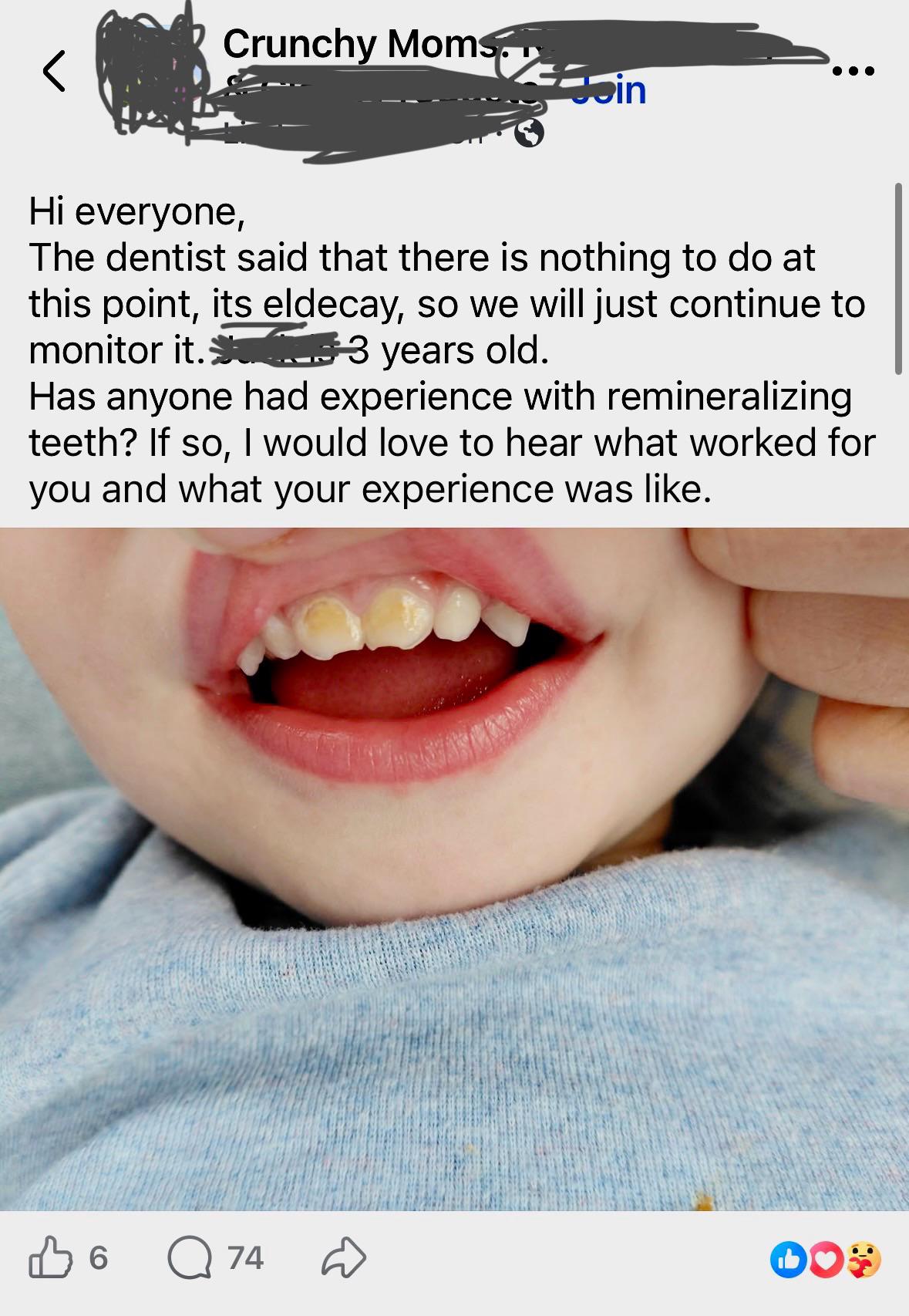
Every single day, there is a photo of a toddler's front teeth and the horrifying guilt that mothers have to go through seeing their children suffer from cavities or sensitive teeth.
Support Strong, Healthy Teeth for Your Children With Remineralizing Gum (Without Painful Procedures)

The truth is, a cavity is a sign of ongoing demineralization.
Demineralization is the process where acid pulls minerals out of the enamel faster than they're replaced. Minerals give your teeth their hardness and strength, especially in the enamel. A perfectly healthy mouth nourishes the enamel and supports its full mineral structure.
Acids love to leach minerals from your teeth just like mosquitoes leach blood when they bite you.
If you don't replace the minerals your tooth enamel loses, the results are entirely predictable: cavities and sensitivity.
But what if you could GIVE it back the minerals it's made of?
That was the question I couldn't stop turning over. And the answer took me somewhere I didn't expect.
Space.
In the 1970s, NASA ran into a problem nobody had planned for. Astronauts were coming home with weakened bones and teeth, because zero gravity strips minerals out of the body, and once they're gone they don't come back on their own.
So researchers went looking for a way to put them back.
What they focused on was a mineral called hydroxyapatite. Calcium and phosphate in a specific crystal form, and the same material that makes up roughly 97% of the enamel on every tooth in your child's mouth.
It's what teeth are actually made from.
Japanese researchers picked up that work and asked the question that changed everything. If hydroxyapatite is what enamel is made of, what happens when you put it directly on the tooth surface?
The answer became a toothpaste ingredient approved in Japan in 1993. It's been sold there for over thirty years.
So the question stopped being how do I get my kids to brush better.
It became: how do I get those minerals onto their teeth during the hours where their teeth is MOST vulnerable to demineralization.
Not at 8 in the morning, not at 8 at night. In the middle of the day, right after the snacks and meals.
That's when I found remineralizing gum.
Introducing Larineco™ Remineralizing Gum
Larineco™ Remineralizing Gum is functional chewing gum designed to support healthy-feeling gums and teeth, powered by nano-hydroxyapatite, the mineral your teeth are made of.
It is not a coating or a numbing agent. It is the actual mineral in nano form, small enough to settle into the microscopic pits and hairline gaps on an enamel surface.
Think of a road full of potholes. You do not paint over them. You fill them back in with the material the road was built from.
Because hydroxyapatite is what enamel is built from, it supports enamel without fluoride.
Because it is a gum, it works where a toothbrush cannot stay. Toothpaste gets two minutes and goes down the drain. Chewing after breakfast, after lunch, or after that afternoon snack means mineral is going back on the surface at exactly the moments acid is coming at it.
Chewing also gets saliva flowing, which is the body's own mineral delivery. Enamel that is not sitting in acid all afternoon can feel cleaner and smoother.
Then there is xylitol. The bacteria on the tooth surface cannot feed on it, so there is less plaque holding acid where you do not want it.
The rest of the formula handles the in-between. Erythritol supports a more neutral pH. Mastic and myrrh support fresher breath instead of masking it. Calcium bentonite clay gently lifts surface stains as you chew. The chicle and acacia base means they are chewing tree sap, not synthetic plastic.
One ingredient replenishes mineral, another works against the bacteria.
This is proactive oral care. It helps replenish what leaves the enamel surface every day, in the window between brushings.
What Makes Larineco™ Different Than Everything Else
It all comes down to one simple idea: direct mineral contact.
Hydroxyapatite is the mineral your child's teeth are already made of. It is the same mineral found in enamel, used here to support the tooth surface.
Here's why toothpaste and rinses fall short:
They brush for two minutes, twice a day. That's four minutes of contact out of twenty-four hours. Then they spit, and whatever was working goes down the drain.
Mouthwash gets even less time. Thirty seconds, then it is rinsed away.
The rest of the day, their enamel is on its own. That happens to be the exact stretch when the snacking is happening.
But when hydroxyapatite stays in contact with the tooth surface:
More contact time than brushing alone
Supports the spots daily acid exposure works against
No extra rinsing step
Fits between brushings, when their toothbrush is not around
It is the difference between a quick pass and support that stays with the routine longer.
Then there's the second half.
Daily mineral support works best when the routine also considers sugar and acid exposure. That's where xylitol comes in. Oral bacteria can feed on sugar and produce acids that work against enamel. Xylitol gives the routine a sugar-free way to support a cleaner-feeling mouth.
What xylitol adds:
Adds sweetness without sugar
Supports a cleaner-feeling mouth
Pairs with the natural saliva flow that comes from chewing
Fits easily into an after-meal routine
One ingredient supports mineral contact. The other helps make the daily routine easier to keep.
PARENTING › ORAL CARE › CAVITIES & SENSITIVITY
I was a COMPLETE failure as a mom. My 6 year-old had several cavities. Then my dentist showed me this viral Remineralizing Gum.
Rachel Baker - Mom of 3 Kids
Updated on August 22, 2026

“Parenting was traumatic. Turns out my kids had several cavities and it breaks my heart knowing the pain they went through. Now I have them chew remineralizing gum to support strong enamel.”
If you're a mom feeling guilty over your kid's cavities, bleeding gums, or sensitivity, read this
Getting your kids to do anything is hard, and getting them to take care of their teeth is EVEN harder.
Brushing and flossing sit right at the top of that list, somewhere between eating vegetables and going to bed on time.
So I did what you do. I reminded them every single night, stood in the doorway and counted, checked their teeth afterward. I did everything I was supposed to do and I did it for years.
Literally a photo of me brushing my little one's teeth for him
Which is why it completely broke me when the dentist counted seven cavities across my three kids in a single afternoon.
We brushed their teeth, and we brushed them often. That's the part I still can't get past, because we were doing it.
Then came the part I wasn't ready for. Two of those cavities were deep enough that my youngest had to be put under anesthesia to get them filled, and I don't think I've ever been more scared than I was sitting in that waiting room. Months of appointments followed, months of drilling and fillings and my kids dealing with something I thought I had been protecting them from the whole time.
I felt like a terrible mom, like I had failed at the one thing that was actually in my control. My heart broke for them.
That was 9 months ago, and what I found out afterward is the reason I'm writing this.
If you're doing everything right and your kid still came home with cavities, give me the next four minutes.
Because what changed for us had nothing to do with brushing harder. It had everything to do with the hours in between.
My name is Rachel, and I want to tell you about the appointment that started all of this.
The Dental Visit That Completely Broke Me
It was a Tuesday afternoon when the dentist stopped counting out loud.
He'd been going tooth by tooth with my youngest, calling numbers to the hygienist, and somewhere around the fourth one his voice changed. Then he swiveled around and looked at me.
My poor little guy had a mouth full of cavities. Six of them, at 6 years old. And when my other two went in that same week:
6-year-old: six cavities, two deep enough to need anesthesia
8-year-old: three cavities
10-year-old: two cavities
Eleven cavities across three kids in a single week.
I sat there feeling like a horrible parent. Because these are the three people I am supposed to be taking care of and I had somehow let this happen to all of them at the same time.
I told him what we did. Brushing twice a day, supervised, every night. No soda in the house. I'd cut them off sugar months ago. When they got hungry between meals I gave them fruit, a slice of bread, crackers, the things you're supposed to give them.
He said it happens to a lot of kids. That some kids are just more prone to it. That was the whole explanation.
I got to my car and I couldn't make myself start it. I had just been told that everything I was doing was right and that my kids had eleven cavities anyway, and I was supposed to accept both of those things at the same time.
So I went home and started researching.
What I found in the first twenty minutes made me sick, because it wasn't complicated and it had nothing to do with my kids being prone to anything.
It was something I had been doing to them myself, every day, for years. Something I'd started because I was trying to be a good mom.
And not one dentist had ever mentioned it.
The Thing Dentists Never Told You (Because They Never Thought To)
Your kid's enamel is made of minerals. Calcium and phosphate, locked into a crystal structure.
And it is under constant attack.
Every time your child eats, bacteria in their mouth feed on the sugars and starches and produce acid. That acid pulls minerals from the enamel and softens it. Dentists call it an acid attack, and it doesn't stop the second your kid swallows.
That's when it hit me.
A candy bar eaten in five minutes is one attack, and the teeth have all afternoon to recover.
But grapes at 10. Crackers at 11:30. Apple slices at 2. A slice of bread at 4.
That's mineral loss happening throughout the day, and their teeth never get a break.
And here's the part that keeps me up.
How often you eat and drink matters more than people realize.
Their adult teeth were coming in. I was watching what they ate. Nobody told me to watch how often. The healthy snacks I was proud of were keeping their teeth under frequent acid pressure throughout the day.
We Made One Small Change
I'd tried so many different approaches to help my children have healthy teeth and gums. Electric toothbrushes. Sticker charts and a timer on the counter. Cutting sugar, then juice, then anything that came in a wrapper.
None of it worked. In fact, the more we tried, the worse the fights got. The more guilty I felt as a mother.
Then I kept seeing moms in those same groups mention a remineralizing gum. So when we tried it, I thought nothing of it. But the change was more than I expected.
I'm not lying awake running the checklist anymore. I'm not white-knuckling their appointments. The bathroom isn't a battle at eight o'clock every night, and my kids actually ask for it themselves now.
For the first time, I feel like I'm doing something during the hours that actually matter, instead of just hoping.
I'm writing this because I cannot open a mom group anymore without seeing another one.
Every single day, there is a photo of a toddler's front teeth and the horrifying guilt that mothers have to go through seeing their children suffer from cavities or sensitive teeth.
Support Strong, Healthy Teeth for Your Children (Without Painful Procedures)
The truth is, a cavity is a sign of ongoing demineralization.
Demineralization is the process where acid pulls minerals out of the enamel faster than they're replaced. Minerals give your teeth their hardness and strength, especially in the enamel. A perfectly healthy mouth nourishes the enamel and supports its full mineral structure.
Acids love to leach minerals from your teeth just like mosquitoes leach blood when they bite you.
If you don't replace the minerals your tooth enamel loses, the results are entirely predictable: cavities and sensitivity.
But what if you could GIVE it back the minerals it's made of?
That was the question I couldn't stop turning over. And the answer took me somewhere I didn't expect.
Space.
In the 1970s, NASA ran into a problem nobody had planned for. Astronauts were coming home with weakened bones and teeth, because zero gravity strips minerals out of the body, and once they're gone they don't come back on their own.
So researchers went looking for a way to put them back.
What they focused on was a mineral called hydroxyapatite. Calcium and phosphate in a specific crystal form, and the same material that makes up roughly 97% of the enamel on every tooth in your child's mouth.
It's what teeth are actually made from.
Japanese researchers picked up that work and asked the question that changed everything. If hydroxyapatite is what enamel is made of, what happens when you put it directly on the tooth surface?
The answer became a toothpaste ingredient approved in Japan in 1993. It's been sold there for over thirty years.
So the question stopped being how do I get my kids to brush better.
It became: how do I get those minerals onto their teeth during the hours where their teeth is MOST vulnerable to demineralization.
Not at 8 in the morning, not at 8 at night. In the middle of the day, right after the snacks and meals.
That's when I found remineralizing gum.
Introducing Larineco™ Remineralizing Gum
Larineco™ Remineralizing Gum is functional chewing gum designed to support healthy-feeling gums and teeth, powered by nano-hydroxyapatite, the mineral your teeth are made of.
It is not a coating or a numbing agent. It is the actual mineral in nano form, small enough to settle into the microscopic pits and hairline gaps on an enamel surface.
Think of a road full of potholes. You do not paint over them. You fill them back in with the material the road was built from.
Because hydroxyapatite is what enamel is built from, it supports enamel without fluoride.
Because it is a gum, it works where a toothbrush cannot stay. Toothpaste gets two minutes and goes down the drain. Chewing after breakfast, after lunch, or after that afternoon snack means mineral is going back on the surface at exactly the moments acid is coming at it.
Chewing also gets saliva flowing, which is the body's own mineral delivery. Enamel that is not sitting in acid all afternoon can feel cleaner and smoother.
Then there is xylitol. The bacteria on the tooth surface cannot feed on it, so there is less plaque holding acid where you do not want it.
The rest of the formula handles the in-between. Erythritol supports a more neutral pH. Mastic and myrrh support fresher breath instead of masking it. Calcium bentonite clay gently lifts surface stains as you chew. The chicle and acacia base means they are chewing tree sap, not synthetic plastic.
One ingredient replenishes mineral, another works against the bacteria.
This is proactive oral care. It helps replenish what leaves the enamel surface every day, in the window between brushings.
What Makes Larineco™ Different Than Everything Else
It all comes down to one simple idea: direct mineral contact.
Hydroxyapatite is the mineral your child's teeth are already made of. It is the same mineral found in enamel, used here to support the tooth surface.
Here's why toothpaste and rinses fall short:
They brush for two minutes, twice a day. That's four minutes of contact out of twenty-four hours. Then they spit, and whatever was working goes down the drain.
Mouthwash gets even less time. Thirty seconds, then it is rinsed away.
The rest of the day, their enamel is on its own. That happens to be the exact stretch when the snacking is happening.
But when hydroxyapatite stays in contact with the tooth surface:
More contact time than brushing alone
Supports the spots daily acid exposure works against
No extra rinsing step
Fits between brushings, when their toothbrush is not around
It is the difference between a quick pass and support that stays with the routine longer.
Then there's the second half.
Daily mineral support works best when the routine also considers sugar and acid exposure. That's where xylitol comes in. Oral bacteria can feed on sugar and produce acids that work against enamel. Xylitol gives the routine a sugar-free way to support a cleaner-feeling mouth.
What xylitol adds:
Adds sweetness without sugar
Supports a cleaner-feeling mouth
Pairs with the natural saliva flow that comes from chewing
Fits easily into an after-meal routine
One ingredient supports mineral contact. The other helps make the daily routine easier to keep.
LIMITED TIME OFFER
Save up to 50% off
Larineco™ Remineralizing Gum - Chewable Oral Care

✓ Supports strong enamel
✓ Helps ease everyday sensitivity
✓ Helps soothe and support healthy gums
✓ Fights bad breath at the source
✓ Great for the whole family
Offer Status
| Sell Out Risk: High
Try it risk-free for 30 days.
What's Inside Larineco™ Remineralizing Gum


Nano-Hydroxyapatite
The same mineral your teeth are made of, helping replenish what everyday acid exposure takes.

Xylitol
A natural sugar-free sweetener that disrupts cavity-causing bacteria and helps cleanse and refresh your mouth.

Chicle
A natural tree sap gum base, so you get a longer, cleaner chew with no synthetic plastics or fillers.

Calcium Bentonite Clay
A mineral-rich clay that helps gently lift surface residue for a brighter-looking smile.

Plant-Based Botanicals
Mastic and myrrh, used in oral care for thousands of years to support a balanced oral environment.

Acacia
A natural plant gum that binds the formula for a smooth, consistent chew.
What's Inside Larineco™ Remineralizing Gum
Nano-Hydroxyapatite
The same mineral your teeth are made of, helping replenish what everyday acid exposure takes.
Xylitol
A natural sugar-free sweetener that disrupts cavity-causing bacteria and helps cleanse and refresh your mouth.
Chicle
A natural tree sap gum base, so you get a longer, cleaner chew with no synthetic plastics or fillers.
Calcium Bentonite Clay
A mineral-rich clay that helps gently lift surface residue for a brighter-looking smile.
Plant-Based Botanicals
Mastic and myrrh, used in oral care for thousands of years to support a balanced oral environment.
Acacia
A natural plant gum that binds the formula for a smooth, consistent chew.
What Parents Are Saying
.png)
My kids fight over who gets the last one
I never thought I'd see the day my six-year-old asks me for something related to his teeth. He calls it his treat. He has no idea it's part of a routine and I am not going to be the one to tell him.
Jessica R., 38
Finally something for their sweet tooth I feel okay about
My daughter would eat candy for every meal if I let her. This is sweet enough that she thinks she's getting away with something. I stopped feeling like the villain about ten minutes into day one.
Nicole B., 36
Bought it for the kids, kept it for me
I got this for my two and ended up keeping a pack in my bag. My mouth feels cleaner through the afternoon and my teeth feel smoother than they have in years. Turns out I needed it as much as they did.
A routine the whole house actually shares
Everyone grabs one after dinner, kids included. It's the only part of oral care in this house that doesn't involve me nagging somebody, and it takes about thirty seconds.
Megan T., 41
What Parents Are Saying
My kids fight over who gets the last one
I never thought I'd see the day my six-year-old asks me for something related to his teeth. He calls it his treat. He has no idea it's part of a routine and I am not going to be the one to tell him.
Jessica R., 38
Finally something for their sweet tooth I feel okay about
My daughter would eat candy for every meal if I let her. This is sweet enough that she thinks she's getting away with something. I stopped feeling like the villain about ten minutes into day one.
Nicole B., 36
Bought it for the kids, kept it for me
I got this for my two and ended up keeping a pack in my bag. My mouth feels cleaner through the afternoon and my teeth feel smoother than they have in years. Turns out I needed it as much as they did.
A routine the whole house actually shares
Everyone grabs one after dinner, kids included. It's the only part of oral care in this house that doesn't involve me nagging somebody, and it takes about thirty seconds.
Megan T., 41
What You May Notice Over Your First Two Months
WEEK 1
Fresher breath that holds
Breath that stays fresh past lunch, not just after brushing. Kids reach for the berry flavor on their own, so the habit starts before they notice it's a habit.
WEEKS 2 TO 4
Cleaner between brushings
That just-brushed feeling lasts further into the day. One after lunch, one after the afternoon snack.
MONTH 1
Oral care becomes part of the routine
Many parents notice their child reaching for one after eating unprompted, and teeth that feel smoother and cleaner than they have in a long time.
MONTH 2
Enamel that feels supported
With continued daily use, a mouth that feels supported through the hours brushing doesn't cover. Less second-guessing between appointments.
Individual results may vary.
Final Verdict: Is It Worth It?

I'd spent years doing everything I was told and still got caught off guard. I brushed their teeth, I supervised, I cut the sugar. My kids still came home with cavities.
None of it gave their enamel the steady mineral support it needed during the hours brushing doesn't cover.
Then my kids started chewing Larineco™ Remineralizing Gum after lunch and their afternoon snack. The part I didn't expect was how much better their mouths felt through the whole day, and how quickly they started reaching for it themselves.
Right now, you have two options.
Path 1. Keep the same routine and hope the hours between brushings take care of themselves.
Path 2. Give their teeth daily mineral support when their toothbrush isn't around. One after meals, and enamel support becomes part of the day.
I know which path I'd pick. I did.
And here's what I'd say to any mom reading this.
People are so quick to blame parents for their kids' cavities. They don't realize how hard we work. I was embarrassed to tell anyone my kids had cavities, because I knew exactly what they'd assume. That I wasn't paying attention. That I was letting them eat junk.
None of it was true.
So if you're the mom in the parking lot right now doing the math on what you did wrong, I hope you find this sooner than I did. It was never about brushing harder. It was about the hours nobody ever told us mattered.
If your kids are brushing twice a day and it still doesn't feel like enough, Larineco™ Remineralizing Gum may be worth trying. It comes with a 30-day money-back guarantee.
UPDATE: Larineco™ Remineralizing Gum Are Flying Off the Shelves!
Since this article has been published, the demand for this gum flavor has gone through the roof. Word is spreading and people are raving about these new Larineco™ pouches. Stock up and lock in your discount while it lasts!
Trusted By 350,000+ Customers

LIMITED OFFER
UP TO 50% OFF FOR A LIMITED TIME ONLY
This limited-time offer is in high demand and popular flavors often sell out.
DEAL ENDING IN: 02:07:08
Sell-Out Risk: High
FREE Shipping over $50
Try it today with a 30-day money-back guarantee.
© 2026 Larineco™. All rights reserved.
What You May Notice Over Your First Two Months
WEEK 1
Fresher breath that holds
Breath that stays fresh past lunch, not just after brushing. Kids reach for the berry flavor on their own, so the habit starts before they notice it's a habit.
WEEKS 2 TO 4
Cleaner between brushings
That just-brushed feeling lasts further into the day. One after lunch, one after the afternoon snack.
MONTH 1
Oral care becomes part of the routine
Many parents notice their child reaching for one after eating unprompted, and teeth that feel smoother and cleaner than they have in a long time.
MONTH 2
Enamel that feels supported
With continued daily use, a mouth that feels supported through the hours brushing doesn't cover. Less second-guessing between appointments.
Individual results may vary.
Final Verdict: Is It Worth It?
I'd spent years doing everything I was told and still got caught off guard. I brushed their teeth, I supervised, I cut the sugar. My kids still came home with cavities.
None of it gave their enamel the steady mineral support it needed during the hours brushing doesn't cover.
Then my kids started chewing Larineco™ Remineralizing Gum after lunch and their afternoon snack. The part I didn't expect was how much better their mouths felt through the whole day, and how quickly they started reaching for it themselves.
Right now, you have two options.
Path 1. Keep the same routine and hope the hours between brushings take care of themselves.
Path 2. Give their teeth daily mineral support when their toothbrush isn't around. One after meals, and enamel support becomes part of the day.
I know which path I'd pick. I did.
And here's what I'd say to any mom reading this.
People are so quick to blame parents for their kids' cavities. They don't realize how hard we work. I was embarrassed to tell anyone my kids had cavities, because I knew exactly what they'd assume. That I wasn't paying attention. That I was letting them eat junk.
None of it was true.
So if you're the mom in the parking lot right now doing the math on what you did wrong, I hope you find this sooner than I did. It was never about brushing harder. It was about the hours nobody ever told us mattered.
If your kids are brushing twice a day and it still doesn't feel like enough, Larineco™ Remineralizing Gum may be worth trying. It comes with a 30-day money-back guarantee.
UPDATE: Larineco™ Remineralizing Gum Are Flying Off the Shelves!
Since this article has been published, the demand for this gum flavor has gone through the roof. Word is spreading and people are raving about these new Larineco™ pouches. Stock up and lock in your discount while it lasts!
Trusted By 350,000+ Customers
LIMITED OFFER
UP TO 50% OFF FOR A LIMITED TIME ONLY
This limited-time offer is in high demand and popular flavors often sell out.
DEAL ENDING IN: 02:07:08
Sell-Out Risk: High
FREE Shipping over $50
Try it today with a 30-day money-back guarantee.
© 2026 Larineco™. All rights reserved.